Agentic Commerce Didn't Skip the Middleman. It Changed Who Gets to Be One.
A year of live agentic-commerce data says the middleman isn't being skipped — retail is being re-intermediated. Discovery has moved to AI surfaces, and legibility to agents now decides who gets the referral.
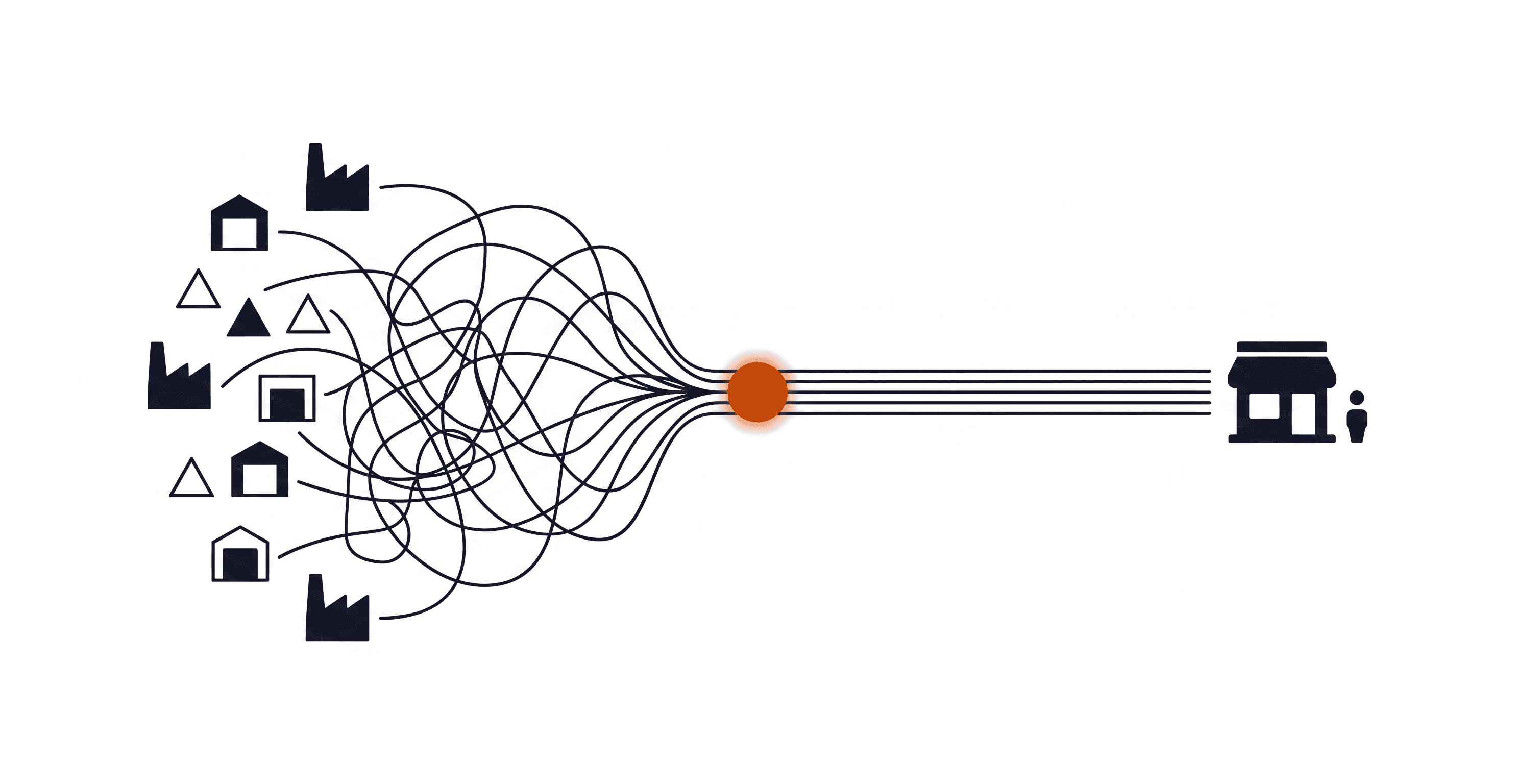
The traditional distribution stack was built on friction. Manufacturers needed wholesalers to aggregate volume, wholesalers needed retailers to reach consumers, and retailers needed shelf space to justify margin at every step. That logic has been squeezed before — department stores squeezed wholesalers a century ago, chains self-distributed, DTC and marketplaces squeezed everyone again — but the stack never disappeared. It re-formed around whoever controlled the scarce resource of the era.
AI buying agents are the newest squeeze, and the tempting conclusion is the one you've read a dozen times: the intermediary layer doesn't get disrupted, it gets skipped. A consumer's agent queries inventory, checks fit, executes the purchase — no retailer required.
We now have almost a year of live data on how this actually plays out. It tells a different, more useful story.
What a year of live rails shows
The infrastructure arrived faster than almost anyone predicted. In the twelve months from April 2025, the card networks shipped Mastercard Agent Pay and Visa Intelligent Commerce; Google launched the Agent Payments Protocol with 60+ partners; OpenAI and Stripe shipped the Agentic Commerce Protocol and ChatGPT Instant Checkout; and Sundar Pichai announced the Universal Commerce Protocol at NRF with Shopify, Etsy, Wayfair, Target, and Walmart as co-developers. By April 2026, AP2 had been donated to the FIDO Alliance, with Visa and Mastercard chairing the payments working group. The transaction layer standardized in record time.
Now look at who's on those rails. US Etsy sellers were live in ChatGPT on day one. Walmart signed with OpenAI roughly two weeks after the ACP launch. Best Buy, Home Depot, and Macy's endorsed UCP. The companies the bypass thesis said would be routed around are the launch partners.
And the demand side is real. Adobe Analytics measured AI-referred traffic to US retail sites up 693% year over year during holiday 2025 and up 393% in Q1 2026 — traffic that converted 38% worse than non-AI traffic in March 2025 and 42% better by March 2026. Salesforce put AI-influenced orders at $262 billion — a fifth of global online orders over the holidays.
But hold those numbers against this one: NIQ finds that while ~34% of consumers now research products with AI, only ~8% have let an agent complete a purchase. As NIQ put it: “Influence is running well ahead of automation.” Accenture's 25,000-consumer study says only 9% would grant an agent full purchase autonomy. Discovery has moved. Influence is mainstream. Autonomous checkout is the still-unclaimed last mile — though Alipay's 120 million agent transactions in a single week this February shows how fast that could change.
The bypass thesis met the checkout button
The single most instructive event of the year: OpenAI pulled back in-chat Instant Checkout in early March 2026, roughly five months after launch, after only about a dozen of Shopify's millions of merchants had gone live. Walmart reportedly measured checkout inside ChatGPT converting roughly three times worse than a click-out to walmart.com. The pattern consumers actually chose: discover in the AI, buy on the merchant's site. Forrester's conclusion is that answer engines will function as referral channels — the new storefront window, not the new store.
Three corrections to the popular story follow directly from the record:
Agents don't negotiate. Every live rail transacts at merchant-set, feed-supplied fixed prices. ACP requires merchants to publish price and availability and has the merchant set a maximum chargeable amount; nothing in ACP, UCP, or AP2 haggles.
Retailers aren't skipped — they're the endpoint. The merchant of record on every live flow is a retailer or marketplace. Amazon, the most prominent holdout — betting on its own agents rather than interoperability — spent the year in court over it, and in August the Ninth Circuit vacated its injunction against Perplexity, holding that when an agent shops on a user's instruction, it's the user accessing the site. The underlying case continues, but the direction is clear: agent access to retail is trending toward a right of the customer, not a favor to the platform.
There was never “no third option” for the margin. Instant Checkout charged merchants a per-transaction fee while it lived, and referral-style economics are emerging in its place. The margin that once funded wholesalers and shelf space doesn't evaporate — part of it is being re-priced as the cost of being findable and trusted by agents. That's re-intermediation. Scot Wingo has made the same point: answer engines are becoming the new intermediary between shoppers and brands.
If you want a preview of how “just go direct” ends, retail already ran the experiment at maximum scale. Nike announced its Consumer Direct Acceleration in 2020 and cut wholesale partners; by late 2023 it was back in Macy's and DSW, by March 2024 its CEO publicly conceded the strategy needed adjustment, and his successor spent his first earnings call rebuilding wholesale relationships. Intermediaries do unglamorous work — reach, inventory absorption, credit, logistics, returns, service — that neither a brand site nor a buying agent replaces.
The same holds double in B2B, where negotiated pricing, trade credit, and ERP-bound workflows are resisting agent automation even as Gartner forecasts most B2B buying will be agent-intermediated by 2028.
The competition is for the referral
If agents are the new referral layer, being chosen is a data problem before it is anything else.
The specs are explicit about the table stakes. OpenAI's product feed requires per-SKU identity, pricing, availability, and returns policy, plus per-SKU eligibility flags, refreshed as often as every 15 minutes. Google disapproves products outright over false identifiers. Adobe's Q1 2026 report on AI traffic doubles as a warning that many retail sites still aren't fully machine-readable.
The stakes are asymmetric. Microsoft's Magentic Marketplace simulations found that shopping agents' decision quality collapses on noisy catalogs — agents grab the first good-enough option rather than browsing. And when the agent gets it wrong, you pay: Rithum's survey found 58% of shoppers blame the retailer or brand — not the AI — for incorrect product information.
And there's a gap in the rails nobody has closed: AP2's signed mandates prove who authorized a purchase and that the cart wasn't tampered with — but the spec explicitly leaves liability and dispute resolution out of scope, and no protocol proves the cart is right. For simple SKUs that's survivable. For configurable and complex products — where compatibility rules, options, and constraints govern what can actually be built and shipped — flat feeds carry no constraint logic at all, and agent surfaces handle them poorly or not at all. A plausible-but-wrong configuration that ships is a return, a chargeback, and per Rithum, a trust hit the brand eats.
Where Retail Reinvented and ConfigIQ come in
This is the work we do, on both sides of the equation.
Retail Reinvented works with operators and brand owners on the strategy layer: agentic readiness assessments, protocol roadmaps (which rails matter for your category and when), and the operating-model changes — pricing governance, feed operations, channel economics — that determine whether AI-referred demand converts or bounces.
ConfigIQ builds the infrastructure layer underneath: a governed product data platform designed as a system of validity, not just a system of record. One governance plane serves two surfaces — the validated catalog, pricing logic, and configuration rules that power your human storefront are the same ones that stand ready to answer an agent's query as the new rails come online. For configurable products, that means an agent doesn't just get an answer; it gets an answer that has been checked against the rules of what can actually be built, priced, and shipped.
In practice the two run as one motion: the readiness assessment tells you where your product data will fail an agent, and the platform is how you fix it — and keep it fixed as the rails move.
The through-line is confident, not defensive: the agentic shift is a chance for retail to flourish, because the rails reward exactly what good retailers already do — accurate catalogs, honest availability, coherent pricing, reliable fulfillment — and now measure it ruthlessly. Adobe's twelve-month conversion swing, from 38% worse to 42% better, is what it looks like when readiness starts paying.
The operator checklist
- Instrument your AI referrals now. You cannot manage a channel you aren't measuring, and it may already be your fastest-growing source of qualified traffic.
- Treat your product feed as a product. Complete, truthful identifiers; honest availability; returns policies; sub-hour freshness. False identifiers get you disapproved outright; ambiguous data gets you skipped by an agent that takes the first clean option. This is the new shelf placement.
- Shop yourself the way an agent does. This quarter, ask the major assistants to find, compare, and buy your products. Everything they get wrong is your roadmap.
- Close the validity gap on complex products. If your catalog has rules — compatibility, configuration, fitment — expose validated answers, not raw attributes. This is where agent-era losses will concentrate, and where almost nobody is ready.
- Decide your posture per rail, not in general. ACP, UCP, and AP2 solve different layers. Match your integration sequence to where your customers' agents actually are.
The original instinct behind all of this is right and worth repeating: the brands that win will be the ones agents can trust. A year of live agentic commerce has simply shown us what trust is made of — and that it's built in your product data, not at the checkout button.